ARG and its Center have conducted a series of National Alcohol Surveys (NAS) of the adult (age 18 and older) US population at approximately 5-year intervals since the 1960s with considerable standardization of measurement methods since 1979 (the 6th NAS or N6). Although not unique in conducting repeated surveys including alcohol questions, the NAS has the longest time frame with commensurate, detailed alcohol use pattern and problem measures, which now extends over 35 years covered by 8 surveys (N6 TO N13), with the most recent survey conducted during 2014 and early 2015.
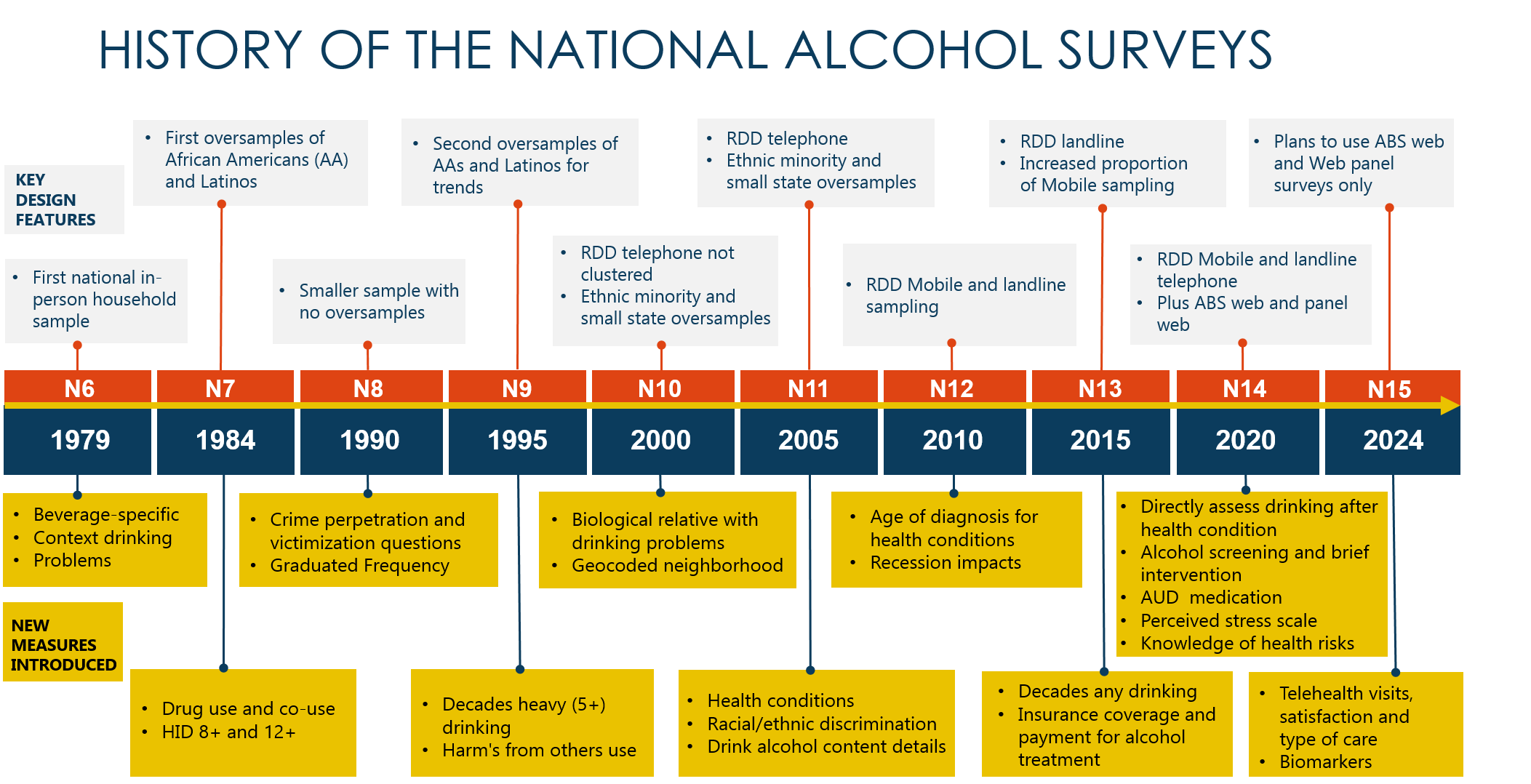
NAS datasets and codebooks for N6 through N13 (2015) are available from ARG after completing the NAS data use agreement form. Links to the files are available below each survey’s description. For more information, please contact study Director Priscilla Martinez, PhD.
National 13, 2014-2015 (N13)
7,071 Random Digit Dial (RDD) nationally representative Computer Assisted Telephone Interview (CATI, of landline (n=4,109) and cellular (n=2,962) phones) of adults aged 18+ in 50 states (plus Washington, DC), with over-samples of Black non-Hispanic (total n = 1,763) and Hispanic (total n = 1,623) groups (with interviews in Spanish for those requesting/needing this). Sample contains 5,634 complete cases and 991 partially-complete cases (defined as those who completed demographics, alcohol consumption patterns, alcohol problems, and alcohol treatment items).
N13 Questionnaire | N13 Data and Codebook
National 12, 2009-2010 (N12)
7,969 Random Digit Dial (RDD) nationally representative Computer Assisted Telephone Interview (CATI, of landline (n=6,855) and cellular (n=1,114) phones) of adults aged 18+ in 50 states (plus Washington, DC), with oversamples of Black non-Hispanic (total n = 1,595) and Hispanic (total n = 1,453) groups (with interviews in Spanish for those requesting/needing this), and including a low-population state oversample (minimum state n = 40). Sample contains 6,394 complete and 1,575 partially complete interviews. These N12 data are currently being analyzed under aims in the National Alcohol Research Center (P50 AA005595). Use by or collaborations with other researchers would be based on discussions with the Center PI (Thomas Greenfield) and under data use agreements.
N12 Landline Questionnaire | N12 Cell Phone Questionnaire | N12 Item Matrix | N12 Data and Codebook
National 11, 2005 (N11)
6,919 Random Digit Dial (RDD) nationally representative Computer Assisted Telephone Interview (CATI of landline phones only) of adults aged 18+ in 50 states (plus Washington DC), with oversamples of Black non-Hispanic (total n=1,054) and Hispanic (total n=1,610) groups (with interviews in Spanish for those requesting/needing this), and including a low-population state oversample (minimum state n = 40).
N11 Data and Codebook
National 10, 2000 (N10)
7,612 Random Digit Dial (RDD) nationally representative Computer Assisted Telephone Interview (CATI of landline phones only) of adults aged 18+ in 50 states (plus Washington DC), with oversamples of Black non-Hispanic (total n = 1,341) and Hispanic (total n=869) groups (with interviews in Spanish for those requesting/needing this) and including a 13 low-population state oversample (n = 341; minimum state n = 50).
N10 Data and Codebook
National 9, 1995 (N9)
4,925 in-person interviews of adults aged 18+, a multi-stage, clustered, survey taken from the 48 contiguous US states (plus Washington DC), on drinking practices and problems, with oversamples of Black non-Hispanic (total n = 1,644) and Hispanic (total n = 1,626) groups (with interviews in Spanish for those requesting/needing this).
N9 Data and Codebook
National 8 Follow-up Survey, 1992-1993 (N8YF)
A follow-up of the youth portion of N8. 91% of previous respondents (n=1027) were re-interviewed. In addition, 261 family members of teens (12-17) interviewed as part of the N8 main sample were also re-interviewed. Fieldwork was conducted for ARG by Temple University Institute of Survey Research (ISR).
National 7 Follow-up Study, 1992 (N7F)(N7FP)
2,247 interviews with a subsample of whites (n=804), Blacks (n=737), and Hispanics (n=706) first interviewed in 1984, plus 583 additional interviews with a sample of 177 white, 189 black and 217 Hispanic youth, ages 18-25. Fieldwork was conducted for ARG by Temple University Institute of Survey Research (ISR).
National 7 Follow-up Tracing Study, 1990
Short questionnaire collected by mail, phone or personal interview from 2,199 respondents to National 7 (1984) survey being traced for follow-up.
National 8, 1990 (N8M)
2,058 interviews on drinking practices and problems and on alcohol and sexuality with a new nationwide sample aged 18+, and 1,110 interviews with a supplementary youth sample aged 12-30. Fieldwork was conducted for ARG by Temple University Institute of Survey Research (ISR).
N8 Data and Codebook
National 7, 1984 (N7)
5,221 interviews on drinking practices and problems with a new nationwide sample aged 18+. (1,941 Blacks, 1,453 Hispanics, and 1,821 others.). Fieldwork was conducted for ARG by Temple University Institute of Survey Research (ISR).
N7 Data | N7 Codebook
National 6, 1979 (N6)
1,772 interviews on drinking practices and problems with a new nationwide sample aged 18+.
N6 Data and Codebook
National 5, 1974 (N5)
901 reinterviews with National II respondents.
National 4, 1973 (N4)
725 reinterviews with National III respondents.
National 3, 1969 (N3)
978 interviews within a new probability sample of U.S. men aged 21-59; completed late 1969.
National 2, 1967 (N2)
1,359 reinterviews with subsample of respondents initially interviewed in 1964-1965 national survey. Conducted March through October 1967.
National 1, 1964/65 (N1)
2,746 interviews with probability sample of adults representative of adults household population of the U.S., exclusive of Hawaii and Alaska. Conducted in late 1964 and early 1965.